
Riparian areas, or the land adjacent to rivers and streams, provide important carbon resources to rivers and streams that support aquatic food webs and influence water quality.
But how drought affects the way carbon moves through riparian zones remains a mystery. Odum School master’s student Devon Locke wants to find out how quickly carbon stored in riparian soils changes under drought, an important question as extreme weather events—such as drought—are expected to become more frequent and intense.
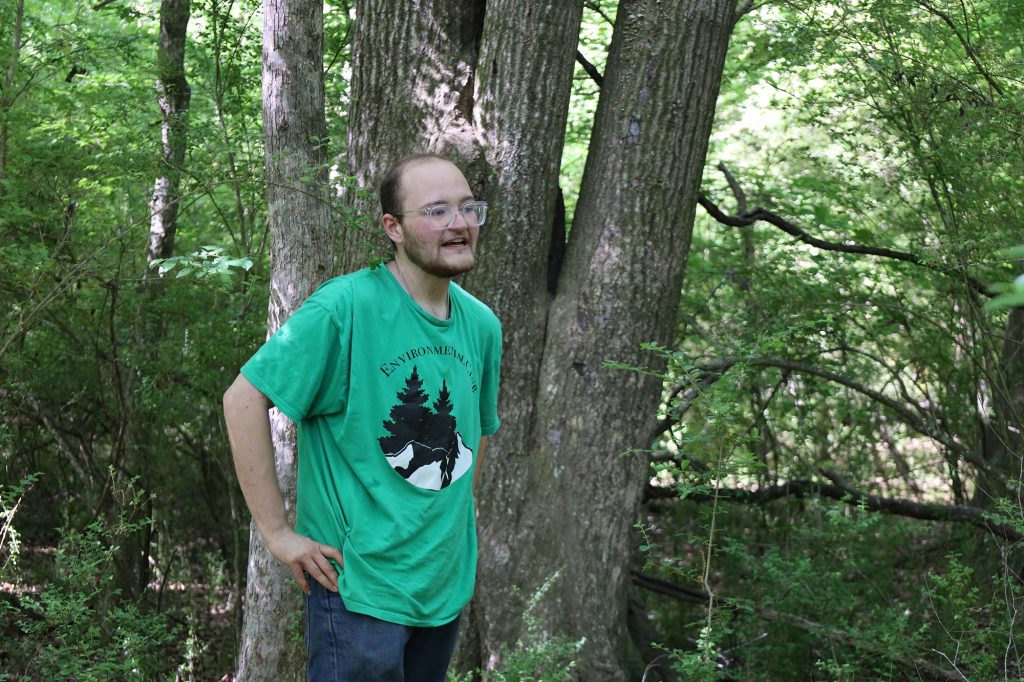
“We’re coupling field and lab work with remote sensing,” said Locke, who is monitoring an area along the North Oconee River for carbon concentrations. “The question is, how are these pools of carbon in riparian zones changing under drought, and can we track these changes on a macro scale with remote sensing?”
Locke, a Spencer Fellow, is working with Associate Professor Krista Capps.
“Devon’s research addresses an important need by examining how water availability in soils controls the movement of carbon from the land into aquatic environments,” said Capps. “Carbon moving from land into river networks forms the foundation of many aquatic food webs, yet there is still much to learn about how water availability influences when, where, and how carbon enters rivers.
“By studying these processes, Devon’s work will help improve our ability to predict how freshwater ecosystems may respond to future environmental change and support more informed decisions about water resources and the communities that depend on them in Georgia and far beyond.”
Locke is conducting this research at Horseshoe Bend Ecological Research Station off College Station Road and at Whitehall Forest on the Clarke-Oconee county line.
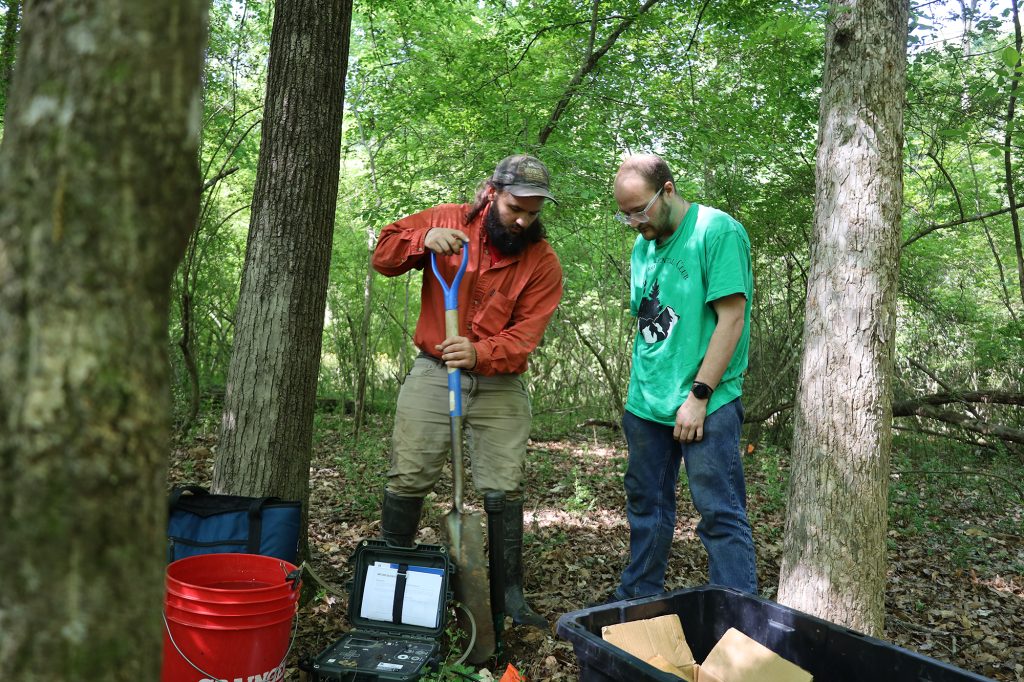
One piece of equipment Locke is using continually monitors soil moisture, temperature and electrical conductivity. Another measures soil hydraulic conductivity—essentially testing how quickly water infiltrates and moves through the soil. A third tracks soil respiration or how much CO2 is being produced by microorganisms in the soil.
Frequent wetting and drying cycles in riparian zones change how quickly carbon is consumed and respired by soil microbes. These cycles also affect how it is moved through the soil and into the stream.
But not all carbon is the same. Locke suspects that labile carbon—the easily biodegradable type—will decline more rapidly than recalcitrant carbon, which is much more resistant to microbial decomposition. His work is testing this prediction.
“Mineral-associated carbon is considered a very slow-cycling pool. So, you wouldn’t expect to see any type of decline over a few months’ time,” Locke said. “However, when you expose a mineral-associated pool to changing water availability and oxygen levels, the rate at which this pool can be broken down and consumed by microbes may increase, moving this carbon into a different part of the environment.”
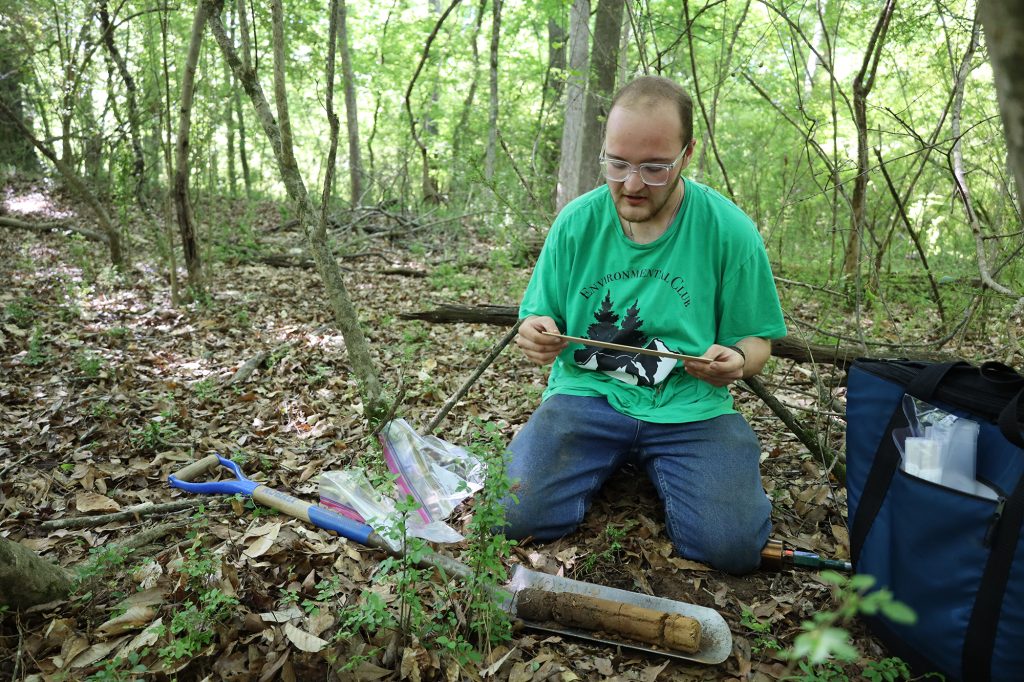
Locke is tackling this research question using multiple approaches, including directly measuring the carbon content of riparian soils by taking samples of cores down to 30 centimeters from the surface. Over the course of the year, he will see whether and how the makeup of carbon changes as the Oconee recovers from severe drought.
“At the end of the day, freshwater ecosystems—lakes and streams—are what connect our terrestrial ecosystem to our ocean,” Locke said. “Changes in the amount of carbon moving from riparian soils to streams have the potential to impact coastal systems.”
Understanding how carbon moves through the environment is critical for predictive models of climate change.
“When we’re thinking about the carbon cycle and how that’s affecting global warming, we base our assumptions on what we know around slow-cycling carbon pools,” Locke said. “But if those cycles are different in a changing world, it may mean that carbon is not being stored in the way we think it is and there could be a greater release of CO2 into our atmosphere.”
Locke will collect data throughout the end of 2026 and look for patterns that could broaden our knowledge of how carbon behaves in riparian zones under drought.
Originally from Crowder, Oklahoma, Locke earned his bachelor’s degree in environmental science and political science from the University of Science and Arts of Oklahoma. There, he conducted research on the biogeochemistry of a former pastureland, examining the effects of ecological restoration on elemental cycling and soil health.
He earned academic honors as an undergrad and chose UGA for its field-based research and its historic leadership in ecological science. His upbringing in a rural community continues to inform his research goals, especially his commitment to advancing environmental policy and ecosystem sustainability, he said.