
Researchers honed their science communications skills on March 20 by distilling complex, innovative work to just five minutes in the 2026 Climate & Water Research Slam.
Over two dozen faculty, graduate students and guests from across campus came together to give lightning talks on an array of water and climate topics: tiny endangered frogs, massive hurricanes, water sustainability on UGA’s campus, and more. Speakers included ecologists, engineers, chemists, marine scientists, anthropologists, soil scientists and sustainability staff.
The Climate and Water Research Slam is held every two years and is a collaborative effort by the River Basin Center, the Office of Sustainability, the Georgia Initiative for Climate and Society, the Institute for Resilient Infrastructure Systems and the Center for Integrative Conservation Research.

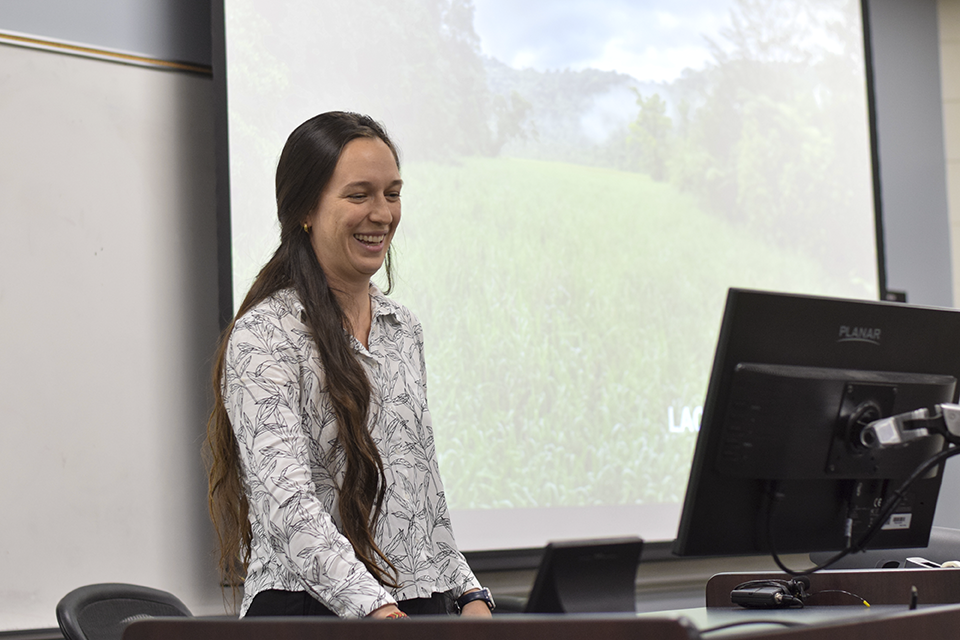

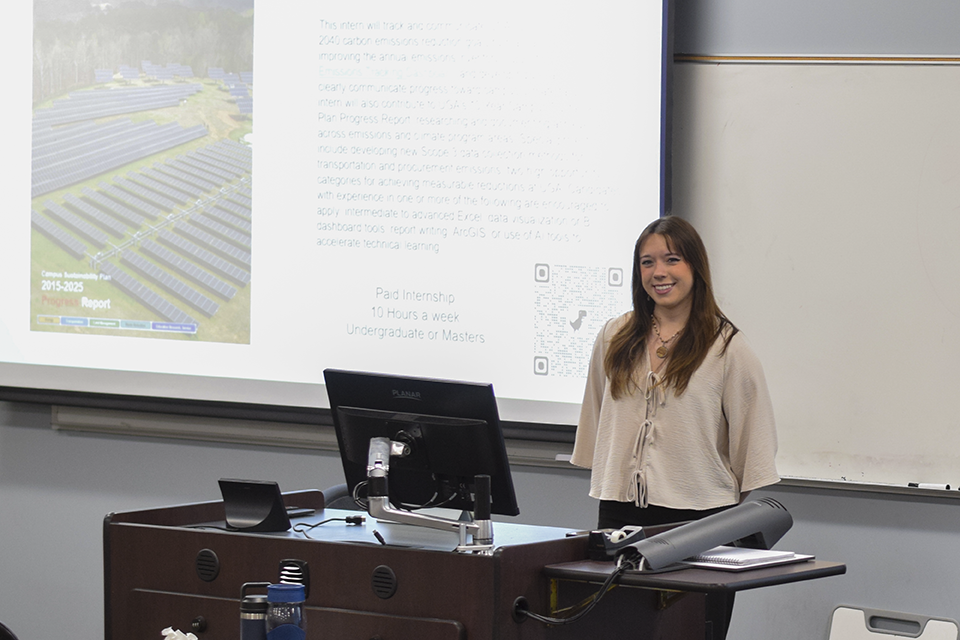

Speakers at the 2026 event included:
Amber Lopez, College of Engineering: Compound Flooding in Puerto Rico
Yubil Tejada, College of Engineering: Otter Creek Wildlife Management Area
Justin Ellis & Becca Golden, Office of Sustainability: Telling UGA’s Emissions Story
Kaili Gregory, Warnell School of Forestry and Natural Resources: Constructed value of information to support alligator harvest decision-making
Katie Kahn, College of Engineering: Applying Thematic Analysis to Identify Conservation Relationships for Coastal Communities
Lía Vergara-Peňa, College of Engineering: Peak discharge frequency-magnitude analysis of extreme weather events under future conditions
Lizzie King, Odum School of Ecology/Warnell School of Forestry and Natural Resources: Pluralism in Environmental Problem-Solving
Marco Garcia, College of Engineering: Integrating Age-Dependent Wave Attenuation and Structural Stability of Red Mangroves for Hybrid Infrastructure
Rajesh Khatakho, College of Engineering: Integrating Physics-Based and Machine Learning Models in a Multi-Aquifer System to Improve GW Level and Drought Prediction
Eric Walther, Odum School of Ecology: Extirpation status of Southeastern freshwater fishes
Maruf Agbaje, Marine Sciences: What Happens to Carbon When a Great River Meets the Sea?
Felix Santiago-Collazo, College of Engineering: Incorporating Local Knowledge into Flood-Mitigating Solution
Abhishek Kumar, Geography: CyanoTRACKER: A Multi-Platform Framework for Monitoring Cyanobacterial Harmful Algal Blooms in Inland Waters
Alejandra Gomez, College of Engineering: Designing for Yesterday’s Stream: A Multi-Benefit Prioritization Framework for Resilient Stream Crossings
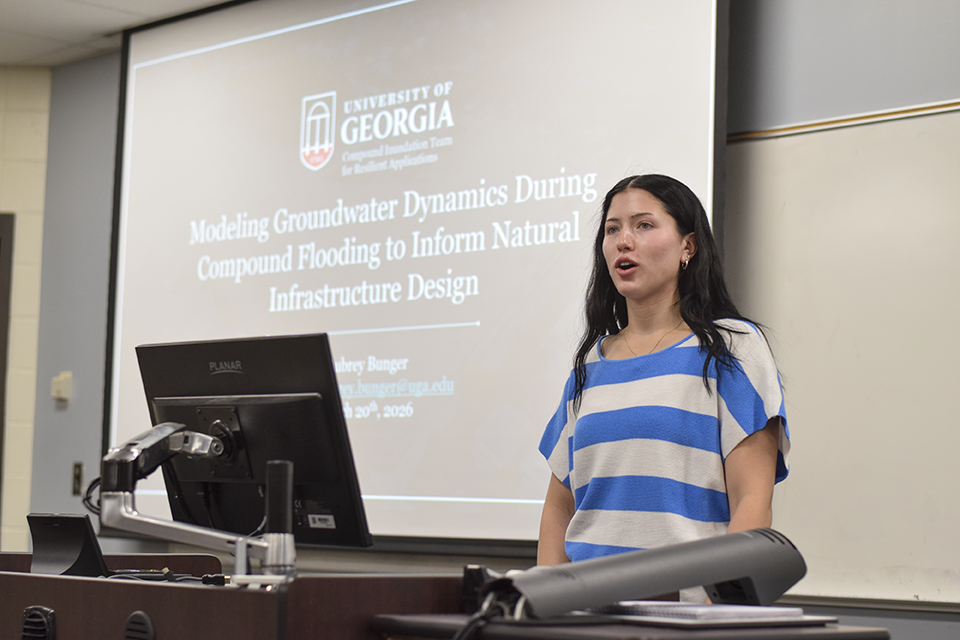
Aubrey Bunger, College of Engineering: Modeling Groundwater Dynamics During Compound Flooding to Inform Natural Infrastructure Design
Bruno Giri, Upper Oconee Watershed Network: Upper Oconee Watershed Network (UOWN) and the importance of community-driven water quality monitoring
Derek McAden, College of Engineering: Phosphorus Dynamics in the Richland Creek Wildlife Management Area Treatment Wetlands
Eiry Roman-Cardona, College of Engineering: Holistic Assessment of Sewer Treatment Wetlands under Climate Change Conditions
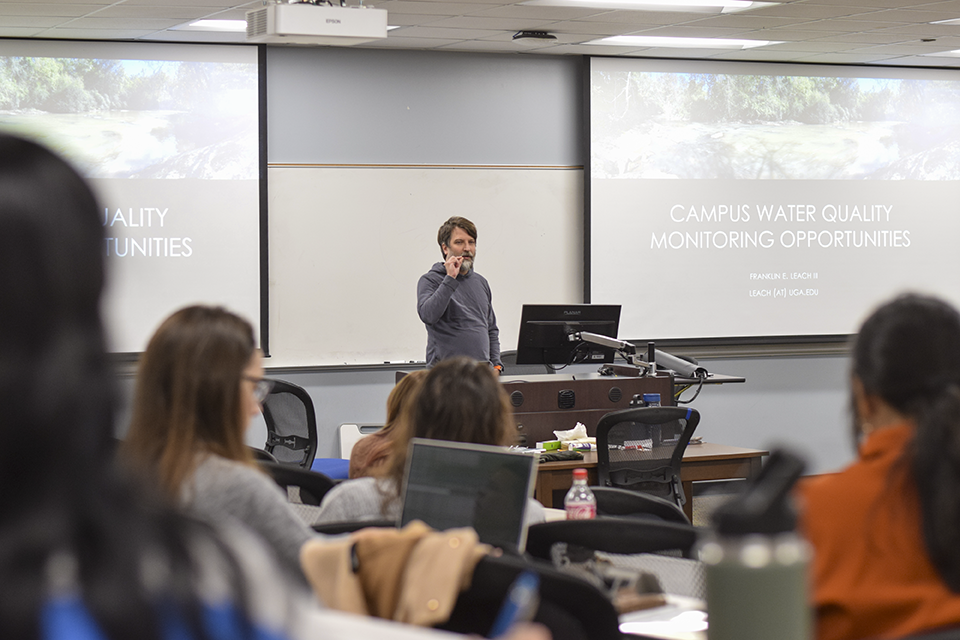
Franklin Leach, Chemistry: Campus Water Quality Monitoring Opportunities
Jason Wheatley, Crop & Soil Sciences: Evaluating the F19 Hydric Soil Indicator using Morphology, Hydrology, and Redox Potential
Laura German, Anthropology: Conservation & Environmental Management Re-imagined: Towards Anti-Oppressive Futures
Paul Okrah, Marine Science: Heat transport dynamics in salt marsh sediments under sea-level rise
Whitney Pagan, College of Engineering: Modeling Water Quantity and Quality in an Integrated Agricultural-Urban Landscape
Valeria Aspinall, Odum School of Ecology: Utilizing bioacoustics to study a micro-endemic and Critically Endangered tree-frog in northern Costa Rica
Patricia Yager, Climate and Society Initiative: Imagine 2036: The One Georgia Climate and Health Extension Center