

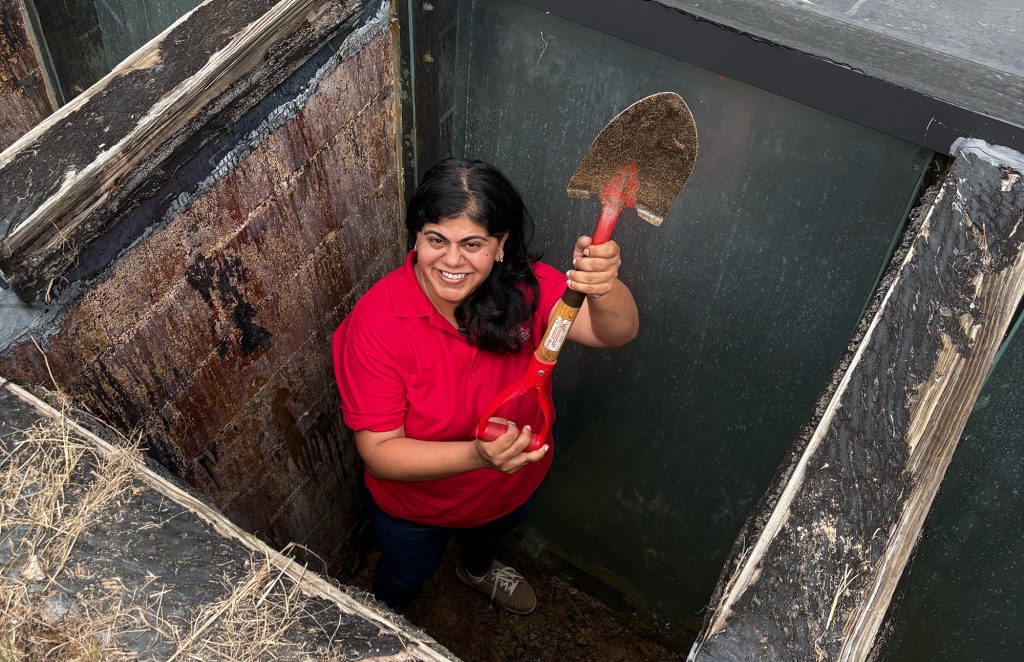
Nandita Gaur
Soil physics
College of Agricultural and Environmental Science
Environmental Soil Physics Lab
Gaur works in the Crop and Soil Sciences Department of the University of Georgia’s College of Agricultural and Environmental Sciences, but her degrees all are in engineering.
“I am a civil engineer, and my PhD was in Bio and Ag engineering. Even though I trained in the realm of engineering, my heart’s always been at engineering’s intersection with the natural environment and its human dimension,” she said.
Gaur’s research focuses on using remote sensing and geophysics to understand soil physics. Some practical applications of that work are understanding how water moves and transports contaminants under different land uses and land covers, as well as the use of remote sensing data for agricultural and environmental applications.

Applied soil science requires us to study soil within its ecosystem, Gaur said, rather than removing it from the ground and attempting to break it down into components. And to do that we require tools like remote sensing and geophysics.
“Soils are a living organism,” she said. “Several years ago, we started talking more about soil health and I think that was a turning point in thinking of soils as an ecosystem. When plants’ roots go in, they create their own ecosystems in soil by nurturing microbes and altering soil structure by intimately interacting with it. For example, plant roots release exudates in response to environmental stresses and to encourage some microbes. These exudates can change the soil structure by aggregating the soil which in turn will change potential for greenhouse gas emission, water movement down through the soil, moisture availability of plants, and circularly, the types of microbes in the soil. It’ll functionally change the soil by making physical alterations to its structure,” she said.
“So, we can’t just study soils, in isolation from all these other factors. We have to look at soils as a whole system, as a heterogeneous system,” she said.
“This aspect especially challenges the traditional methods of studying the physics of the soil through lab based measurements. When we extract soils from the ground to bring into the lab, allow a sample to sit in a freezer, causing the roots to die and micro-organisms to stop functioning, we end up altering the very structure we want to study in the first place. When I study soils in the lab, they’re functionally not the same soils that they were out in the field. They’re not going to hydrologically behave the same way.
“However, that is where a lot of the historical data has been collected and will continue to be collected because of established methods and the logistics of collecting it. For that reason, besides geophysics based on-field work, a lot of my focus is also on trying to translate what knowledge about soil parameters generated in the lab means for field applications.”
Gaur’s current research projects include using geophysics to map soil textures in the field and remote sensors to study soil hydrology. Working closely with colleagues in Crop and Soil Sciences, Ecology, Warnell School of Forestry, Public Health, and Plant biology, she is coupling that with traditional soil work, and exploring how soil structure changes under different management practices and whether agriculture, urban land uses or even wastewater disposal changes the hydrological or biogeochemical functionality of soils.
“I want to quantify the change in the physics and consequent functionality of soils in response to different management practices. My vision is for this understanding to translate into tools that enable better decisions for water and wastewater management, land-use planning, or the development of more efficient nutrient management plans. This applied potential of my work keeps me motivated.”
One of the features that attracted Gaur to UGA is that she likes to work in interdisciplinary teams rather than in silos, she said.
“At UGA, I’ve truly been able to do interdisciplinary science, and that’s what I love about this job,” she said. “The RBC and IRIS (the Institute for Resilient Infrastructure Systems) both have made interdisciplinary research possible because they create a sense of camaraderie with colleagues and connect scientists from different disciplines together. They have also been instrumental in helping create a shared vocabulary for scientists from different backgrounds to communicate about water issues.”
When she arrived in Georgia from Texas seven years ago, Gaur didn’t have a background in the problems facing Georgians or the agencies working to solve those problems. “Because I like applied science so much … I like solving problems and helping people, I really appreciated how the RBC integrated me into the state, what’s going on, problems in the state. It gave me a chance to contribute to solving applied problems statewide,” she said.
Aside from agricultural applications, one of her current favorite projects is her collaboration with Dr. Krista Capps in Ecology to understand how septic systems and their management impact soil functionality and ecology at a landscape scale. While agricultural and wastewater projects are very different, the soil questions are the same.
“The hydrological loading, the nutrient loading, the kind of microbes that grow may be different, but water and all it takes with it, moves through the soil as a function of its soil structure,” she said. “So despite being very different applications, at its core, all this work leads to the same goal- to quantitatively understand the impact of land management practices in changing the physical nature of soils and consequently their functionality.”