

Master’s degree, Odum School of Ecology
2025 Spencer Grant
Chalfin came to the University of Georgia as staff, not as a student.
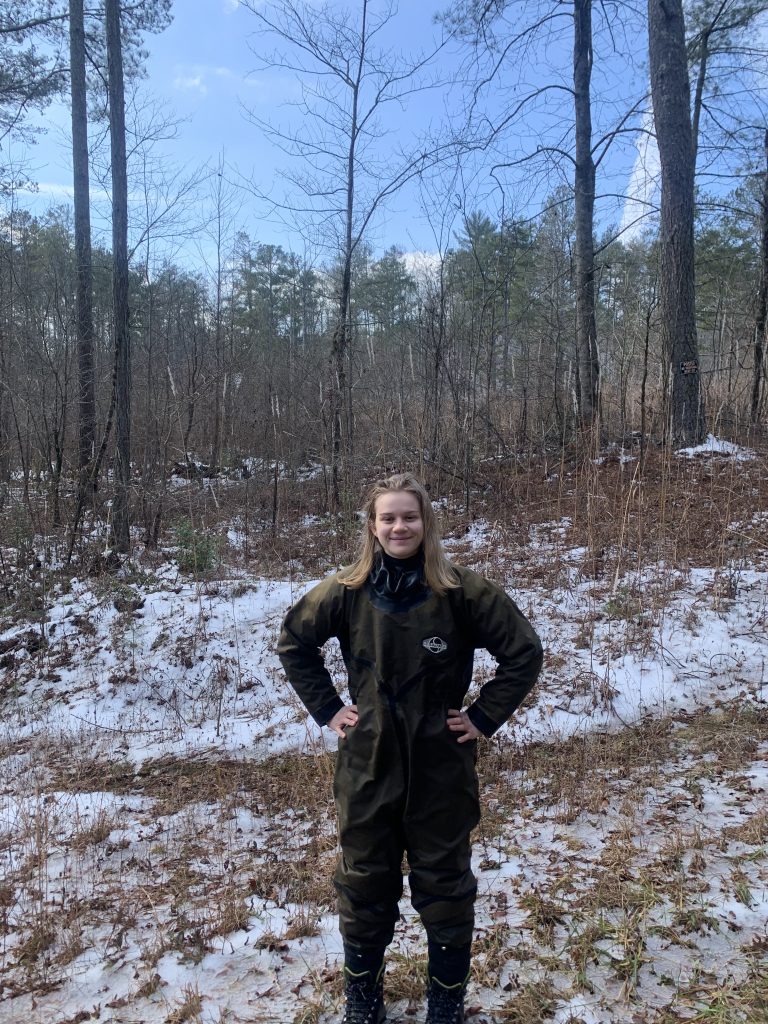
From Natick, Mass., Chalfin did her undergraduate degree at the University of Massachusetts, Amherst, where she met UGA-alum Allison Roy, who recommended her for a research technician job with the River Basin Center in 2022. From there, she stuck around to get a master’s degree.
Chalfin’s research involves describing the habitat use and modeling the distribution of the Etowah Bridled Darter, a species that first was described four years ago and named Percina freemanorum in honor of ecologists Bud and Mary Freeman.
This newly-described species is found only in the Etowah River basin in Georgia. Although it is on the state list of endangered species and is under consideration for federal protected status, its conservation is hampered by a lack of information on what the species needs to thrive.
Chalfin and her advisors worked with the Georgia Department of Natural Resources and the Tennessee Aquarium to identify the most pressing research needs, then snorkeled all the places with known Etowah bridled darter populations.
The Spencer Grant allowed her to hire an undergraduate student, Emma Mainer, to assist her in the field.
“Not only was this money crucial for me finishing my field season, but it also provided Emma with her first ever technician job and gave her excellent research and field experience,” Chalfin said.
“We found that the Etowah Bridled Darter is very limited in its distribution, probably due to human impacts,” she said. Her findings add to evidence from other studies to show that the minnow is less of a habitat generalist than previously thought.
Along with her in-stream observations, Chalfin built a species distribution model to determine which watershed characteristics (such as elevation and historical agriculture) are important to the fish.
“Using the two scales together, we were able to strengthen the modeling and practically link our visual observations to management,” she said. “An additional element to the work is evaluating how these two scales of study can complement one another. Neither approach is novel but it is uncommon to use them together.”
Chalfin defended her thesis this semester and is exploring both jobs and a potential PhD degree.