

PhD, Warnell School of Forestry and Natural Resources
2024 Spencer Grant
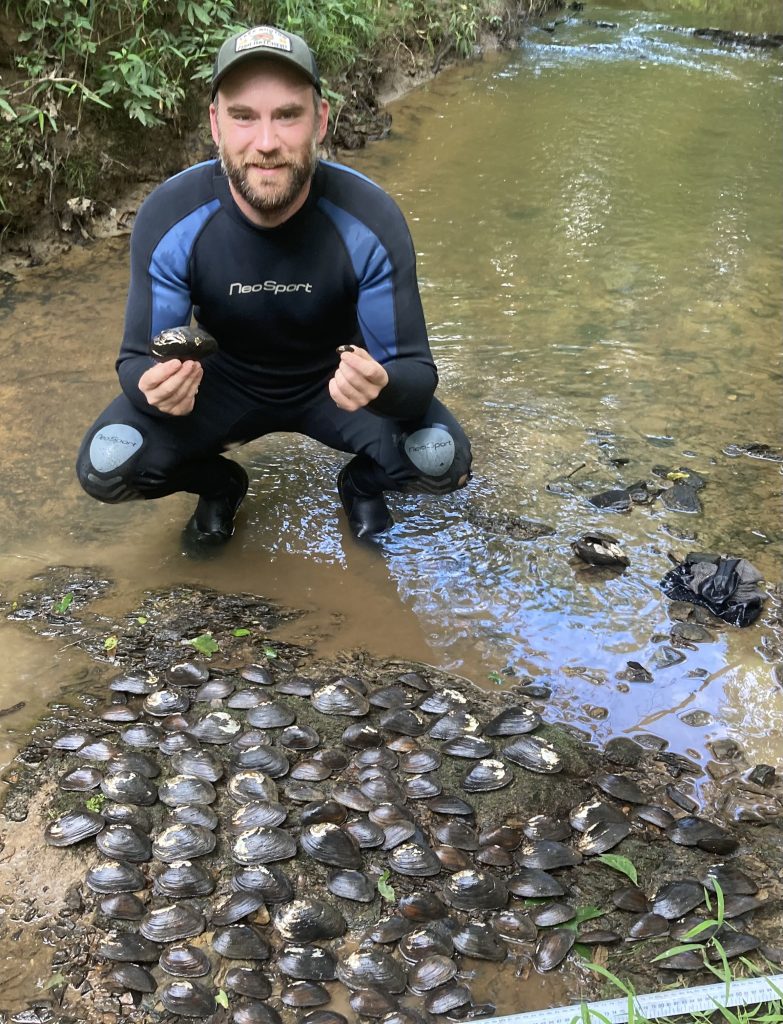
Michael Baker completed two master’s degrees—forestry and natural resources and then statistics—before starting a PhD at Warnell. He plans to graduate in May.
The research for his PhD focused on a state-listed species of freshwater mussel, called the Brook Floater (Alasmidonta varicosa) that lives along the East Coast of the US and Canada.
Baker is estimating demographic parameters for populations of Brook Floaters both in the Northeast and the Southeast. He also is using data simulation to develop improved sampling methodologies for freshwater mussels in general.
“Mussels tend to be patchily distributed, low in number, and elusive (mostly buried in the stream substrate) so some of the modeling approaches that we use on lots of other taxa can have additional complexities when used for mussels,” Baker said.
Mussels also aren’t a high priority for funding, so many common sampling techniques in the fish and wildlife worlds just haven’t been practiced much on mussels.
Baker used Spencer Grant funding to attend meetings where his presentations won awards:
- Georgia Chapter American Fisheries Society (2nd place Best Student Oral Presentation)
- Southern Division American Fisheries Society (1st place Best PhD Student Paper)
- Freshwater Mollusk Conservation Society Meeting (2nd place Best Student Oral Presentation)
“One of the most interesting aspects of this research to me is how it can be used by managing agencies to design monitoring programs which actually will be able to answer the biological questions that they set out to answer,” Baker said. “There’s broad agreement in the wildlife/fisheries fields that techniques like power analysis are really useful in determining how to design studies and determining how much sampling needs to take place to get robust answers, but in practice they are actually used very infrequently. As a result, lots of monitoring is done without enough thought on the front end to make sure that the sampling design will be capable of answering the research questions with the precision that is needed to drive management action.
“I think moving forward, this will be a bigger and bigger issue in our fields as funding sources become more scarce and harder decisions have to be made about how to prioritize research resources.”
Baker has started to look for jobs and is pursuing a position as a biometrician or statistician for a state or federal agency working with wildlife and fisheries data. “Particularly, I am interested in sampling design questions and how we can balance the need for statistically rigorous studies with the unique logistical challenges that arise in each of our natural systems,” he said.